


Sustainability [Actions for the Environment]
FSC® Forest Certification System
Why we worked to obtain FSC® certification
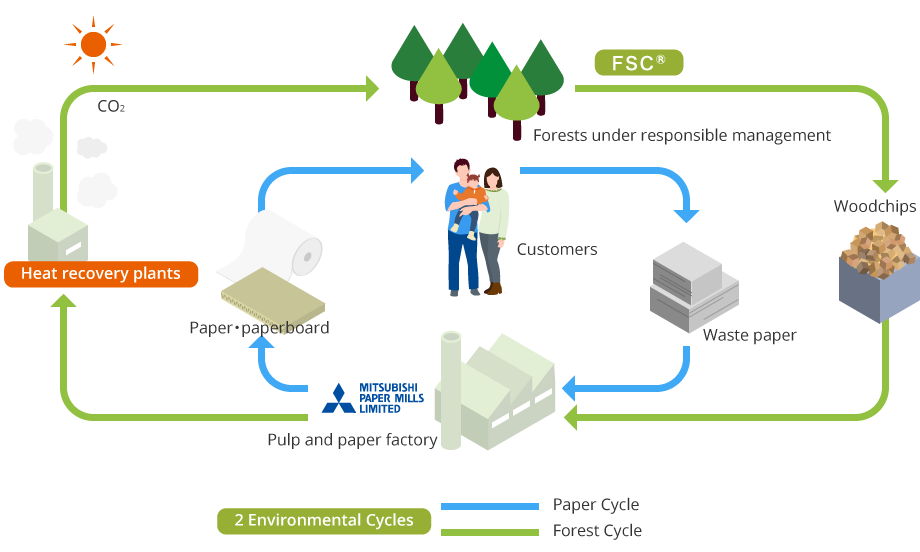
As shown in the diagram below, two cycles are involved in the creation of paper - the paper cycle, which centers on the recycling of waste paper, and the forest cycle, in which CO2 is fixed in the form of trees. As Mitsubishi Paper Mills produces types of paper where high quality is required, such as coated paper and inkjet printer paper, we were unable to use recycled fiber in the manufacture of many of our products.
For this reason, we sought to include environmental considerations in the forest cycle. Here, it is essential that forests are well managed. That is to say, forest management must take into account the forest ecosystems, and conserve forest resources. To ensure that the forest cycle functions effectively, we obtained FSC certification since 2001.
Biodiversity Conservation and FSC® Certification
The certification system operated by the Forest Stewardship Council is intended to help conserve the world's forests by assessing and certifying responsible forest management from the economic, environmental, and social viewpoints and by awarding the FSC label to timber and forest products resulting from such responsible forest management.
Specifically, to receive the FSC® label, organizations must comply with FSC's 10 Principles. With respect to biodiversity, recipients of FSC® certification are required to comply with Principle 6, which mandates the protection of rare and endangered species, and Principle 9, which mandates the maintenance of High Conservation Value Forests (HCVF), forests with high concentrations of biodiversity values. The system is based on the premise that the production of paper in line with the rules laid down by the FSC® will help reduce the adverse impact of human activities on biodiversity.
THE 10 FSC® PRINCIPLES
PRINCIPLE 1: The Organization shall comply with all applicable laws, regulations and nationally-ratified international treaties, conventions and agreements.
PRINCIPLE 2: The Organization shall maintain or enhance the social and economic wellbeing of workers.
PRINCIPLE 3: The Organization shall identify and uphold Indigenous Peoples' legal and customary rights of ownership, use and management of land, territories and resources affected by management activities.
PRINCIPLE 4: The Organization shall contribute to maintaining or enhancing the social and economic wellbeing of local communities.
PRINCIPLE 5: The Organization shall efficiently manage the range of multiple products and services of the Management Unit to maintain or enhance long term economic viability and the range of environmental and social benefits.
PRINCIPLE 6: The Organization shall maintain, conserve and/or restore ecosystem services and environmental values of the Management Unit, and shall avoid, repair or mitigate negative environmental impacts.
PRINCIPLE 7: The Organization shall have a management plan consistent with its policies and objectives and proportionate to scale, intensity and risks of its management activities. The management plan shall be implemented and kept up to date based on monitoring information in order to promote adaptive management. The associated planning and procedural documentation shall be sufficient to guide staff, inform affected stakeholders and interested stakeholders and to justify management decisions.
PRINCIPLE 8: The Organization shall demonstrate that, progress towards achieving the management objectives, the impacts of management activities and the condition of the Management Unit, are monitored and evaluated proportionate to the scale, intensity and risk of management activities, in order to implement adaptive management.
PRINCIPLE 9: The Organization shall maintain and/or enhance the High Conservation Values in the Management Unit through applying the precautionary approach.
PRINCIPLE 10: Management activities conducted by or for The Organization for the Management Unit shall be selected and implemented consistent with The Organization's economic, environmental and social policies and objectives and in compliance with the Principles and Criteria collectively.
Core Labour Requirements in FSC® Forest Certification.
We respect the FSC® Core Labour Requirements as set out in the COC standard for the FSC® Forest Certification Scheme (FSC-STD-40-004) and express the following policy to protect the human rights of workers involved in forest certification.
Policy Including FSC® Core Labour Requirements.
- Prohibition of child labour
Children under the minimum age for employment set by national and regional legislation are not allowed to work. - Elimination of forced labour.
We do not enforce unfair work in any form of employment. - Elimination of discrimination in occupation and employment
We respect basic human rights and do not engage in acts that ignore human rights, such as discrimination based on nationality, race, place of origin, gender, religion, disease or disability, sexual harassment or power harassment. - Respect for freedom of association and the right to collective bargaining
We support the universal principles advocated by the UN (freedom of association and recognition of the right to collective bargaining).
Obtaining FSC® Certification
In 2001 our Hachinohe Mill became the first paper mill in Japan to obtain CoC (Chain-of-Custody) certification, and we began the production of FSC-certified paper. Subsequently, one after another we obtained CoC certification for our other paper mills in Japan, and expanded the number of our FSC-certified products.
With the obtaining of CoC certification in 2007 by German subsidiary Mitsubishi HiTec Paper Flensburg GmbH, all paper manufacturing facilities in the Mitsubishi Paper Mills Group became FSC-certified. We are currently working to obtain FM certification for our forest holdings within Japan, and have already achieved this for three forests in Aomori, Iwate, and Fukushima prefectures.
FSC®-certified Facilities in the Mitsubishi Paper Mills Group
| Forest management | Iwaizumi forest (Japan) | SA-FM/COC-001289 |
|---|---|---|
| Shirakawa and Shichinohe forest (Japan) | SA-FM/COC-002322 | |
| Paper production | Mitsubishi Paper Mills (Japan) -Head Office -Hachinohe Mill -Takasago Mill -Kyoto Mill -Kitakami Mill -MOC (MPM Operation) -MOH (MPM Oji Home Products) |
SCS-COC-000328 |
| Mitsubishi Paper Mills (Japan) -Fuji Mill |
SGSHK-COC-006878 | |
| Mitsubishi HiTec Paper Europe GmbH (Germany) Bielefeld Mill |
SGSCH-COC-002664 | |
| Sales | Mitsubishi Oji Paper Sales (Japan) | SCS-COC-000424 |
| Mitsubishi Imaging (MPM) (USA) | SW-COC-001431 |
